
Bangladesh advances climate-health resilience through community systems strengthening
Categories: Access to climate change funding for health, South East Asia, Climate Resilient Health Systems
Publisher: The Global Fund to Fight AIDS, Tuberculosis and Malaria
Country: Bangladesh
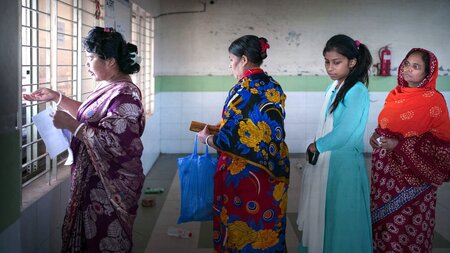 Credit: WHO / Fabeha Monir
 With financial support from the Global Fund, the Government of Bangladesh and the Bangladesh Rural Advancement Committee (BRAC) have launched a community-led climate adaptation initiative to address climate-induced health threats such as dengue, malaria, tuberculosis, and other climate sensitive diseases particularly among displaced and low-income groups including urban informal settlements.
The project is mapping climate migrants and collecting granular health data through Community Health Workers (CHWs) and Community Mobilizers (CMs). Data focuses on symptoms of vector-borne (dengue, malaria), water-borne (diarrheal diseases, cholera), TB, HIV, and heat-related illnesses. These datasets are analyzed jointly by epidemiologists, entomologists, and meteorologists to generate predictive insights, linking disease trends with climate variables and patterns of displacement.
Frontline health workers are receiving specialized training in climate-sensitive illnesses, gender-responsive health service delivery, and disaster response protocols. At the same time, an Emergency Responder Group—comprising youth, teachers, religious leaders, and civil society members—is being mobilized to conduct rapid awareness campaigns and provide immediate support during outbreaks and extreme weather events. Campaigns are focused on preventing and responding to dengue, malaria, HIV, TB, water-borne diseases, and heat stress, with activities such as miking campaigns, dengue clean-up drives, and dissemination of climate-health messages adapted to local contexts. The project also promotes household and community-level practices such as improved hygiene, safe water handling, mosquito breeding site elimination, early care-seeking for fevers, and adherence to TB/HIV treatment despite climate disruptions. These are reinforced through courtyard meetings, advocacy workshops, and youth-led campaigns in high-risk districts.
To ensure long-term sustainability and policy alignment, an inter-ministerial coordination platform is being established with the leadership of the National Malaria Elimination Programme (NMEP), with participation from key ministries, the meteorological department, and the Institute of Epidemiology, Disease Control and Research. This platform will steer the integration of climate-health priorities into national policies, financing strategies, and international commitments, such as the National Adaptation Plan (NAP) and other reporting processes.